Retired Wind-Turbine Blades Field Infographic
This is a Infographics & Diagrams AI image prompt case, leaning toward 数据叙事, 主题信息图, 精确标注. Copy the full prompt below and paste it into a free GPT image generator to create your own image with GPT Image-2 — swap the subject, brand, or aspect ratio as needed.
English full prompt
Translate clearly explaining the structure, relationships, and actionable cues of “Retired Wind-Turbine Blades” into one self-contained image titled “Retired Wind-Turbine Blades. ” Build the infographic by asking the image to unfold a blade section by fabrication medium layers, connecting cutting, milling, pyrolysis, and remanufacture to residue rates, allowing cause, time, location, or quantity to follow one unmistakable route. Unfold a blade section by surface layers, connecting cutting, milling, pyrolysis, and remanufacture to residue rates. In Retired Wind-Turbine Blades, stage each variable beside the element it describes: numbers carry sequence, arrows carry direction, scale cues carry magnitude, and tonal steps express relative intensity; omit percentages when no verified quantity is supplied. Present Retired Wind-Turbine Blades as nine-cell rhythm alongside a dominant center, seen using a near-orthographic eye-level or overhead view alongside macro explanation only where needed. Build the type hierarchy around “复合材料再生路线,” keeping support labels within two lines and away from the central evidence. Use plum violet, smoke gray, copper gold, and cream as the complete palette and focus material detail on crisp vector lines, matte paper grain, translucent overlays, and a one-to-one legend, with physically correct reflection, indentation, and shadow. The visual conditions for Retired Wind-Turbine Blades are natural window light, one sight line shared by the hero view and detail, and a seamless matte neutral background. Across the hero element, align vector edges, arrow endpoints, legend swatches, and translucent overlays precisely. Arrange readable language as medium-weight headline using fine annotations and close the composition using a clean editorial-infographic finish. Additional control: natural cast shadows using soft edges; transparent and opaque boundaries stay accurate. Use a limited matte-to-soft-gloss contrast, ensure hero and annotation zones remain equally legible, and let the highest-contrast point become the reading entry. Remove conflicting arrows, mismatched legends, fabricated statistics, dense microtext, or decorative dashboards; every object needs support, every operation valid ergonomics, and every label legibility. Return one 1:1 final image without variants or a process sheet. Final art direction: clear information design with a coherent visual route and restrained editorial structure. Use this controlled palette as the dominant visual system: #F2EFE7, #27384B, #6D8F89, #C96A43; preserve believable local material colors within it. Preserve the requested text hierarchy and wording as part of the design, but do not invent extra slogans, pseudo-text, logos, or watermarks. Keep one unmistakable primary subject or information route and one readable visual action. Use disciplined negative space and avoid default perfect symmetry. Physical credibility is mandatory: correct gravity, contact shadows, material thickness, tool weight, joint loading, fabric tension, liquid direction, reflections, scale, and occlusion. Create an original visual with no resemblance to a public figure, copyrighted character, existing campaign, or living artist signature style. No unrelated decorative icons, floating objects, duplicated limbs, plastic gloss, waxy skin, synthetic collage artifacts, or AI watermarks. Return exactly one finished image composed for 1:1; no variants, process sheet, split panels, mockup frame, or contact sheet.
中文完整提示词
把直观解释「复合材料再生路线」的结构、关系与行动线索转化为一张独立成片,标题为「复合材料再生路线」。
以叶片截面沿材料层级展开,切割、粉碎、热解和再造对应不同残留率搭建整张信息图,因果、时间、空间或数量关系沿一条明确路径展开
叶片截面沿材料层级展开,切割、粉碎、热解和再造对应不同残留率
把「复合材料再生路线」的每一项主题变量径直放在对应对象旁:编号承担顺序,箭头承担方向,尺度承担量级,相对色阶只表达强弱;缺少可靠数值时不填造百分比。
以九宫格节奏但突出中央单元构图,按接近正交的平视或俯视图,必要局部用微距示意取景。
文字层级以「复合材料再生路线」为首,辅助标签控制在两行内,不遮挡主角证据。
综合色彩为梅紫、烟灰、铜金与奶油白,表面工艺重点是清晰矢量线、哑光纸纹、半透明叠色与可逐项对应的图例,反射、压痕和阴影符合物理规律。
「复合材料再生路线」的视觉条件依次是窗边自然光、主视觉与局部说明共享一条视线、无缝哑光中性色背景;矢量边缘、箭头端点、图例色块和半透明叠层确保精确对齐。可见文字按中等字重标题配细号注释编排,并以清爽的编辑信息图质感结束。补充控制:边缘柔和的自然投影,透明与不透明边界准确;让哑光与微亮表面构成小面积对比,主视觉清晰,注释区确保同等可读,对比最高的位置就是阅读入口。
清除箭头相互冲突、图例错配、伪统计、密集小字与装饰性仪表盘,保证各个物件有支撑、各个动势合乎人体工学、各个标注可读。
成片为单张 1:1,不附过程页或变体。
Related cases
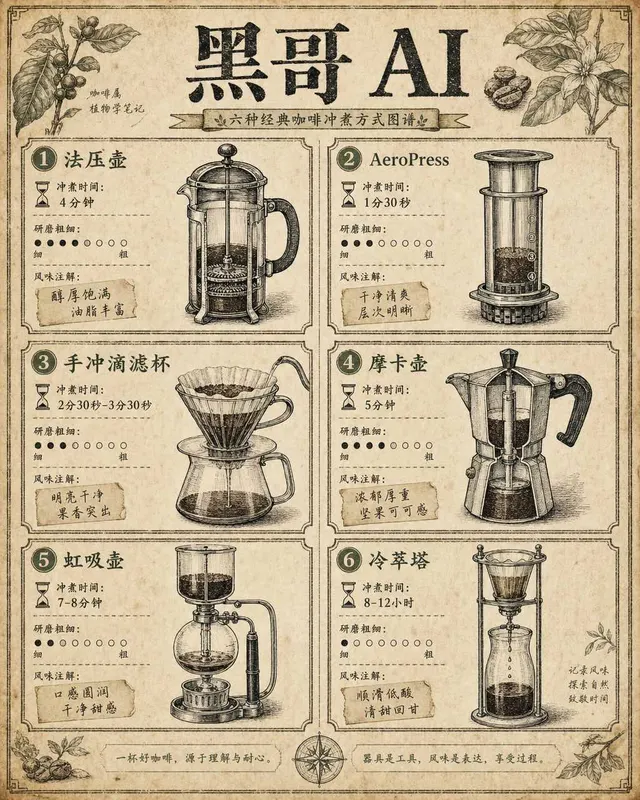
Coffee Brewing Methods Comparison Chart
A vintage-encyclopedia-style infographic comparing six coffee brewing methods arranged in a two-column grid on aged cream paper. Each cell contains a hand-inked cross-section illu…
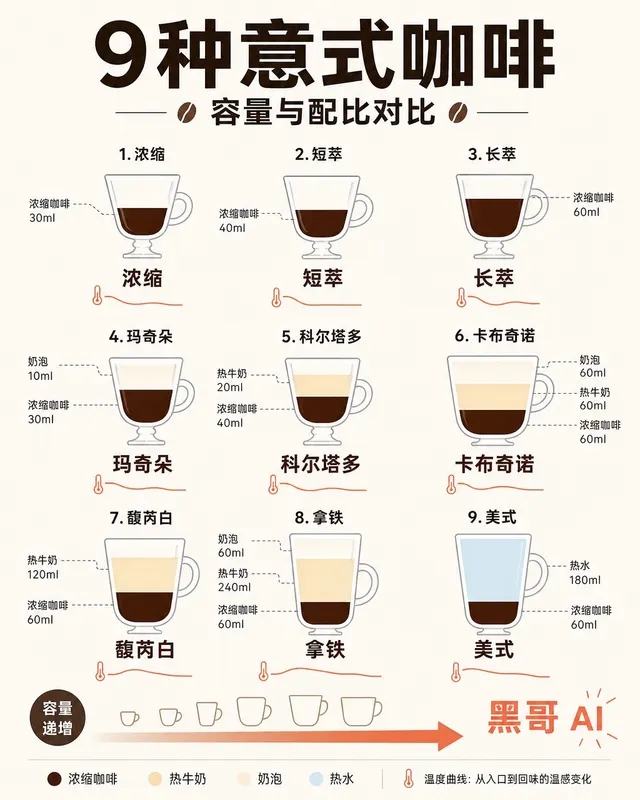
Espresso Drink Ratios Diagram
A clean flat-design infographic illustrating nine espresso-based drinks — espresso, ristretto, lungo, macchiato, cortado, cappuccino, flat white, latte, and americano — as tall ve…
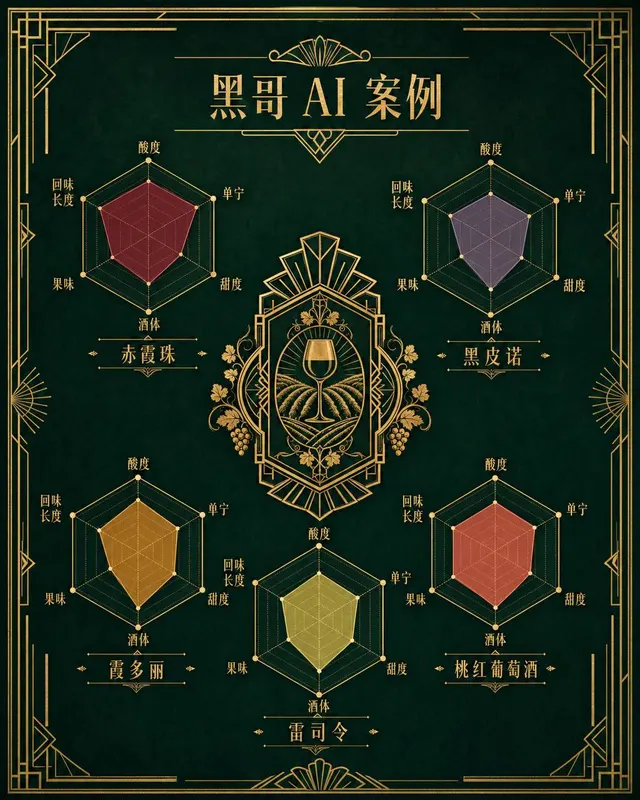
Wine Taste Profile Radar Chart
An art-deco-inspired infographic poster presenting taste-profile radar charts for five classic wines: Cabernet Sauvignon, Pinot Noir, Chardonnay, Riesling, and Rosé. The five hexa…
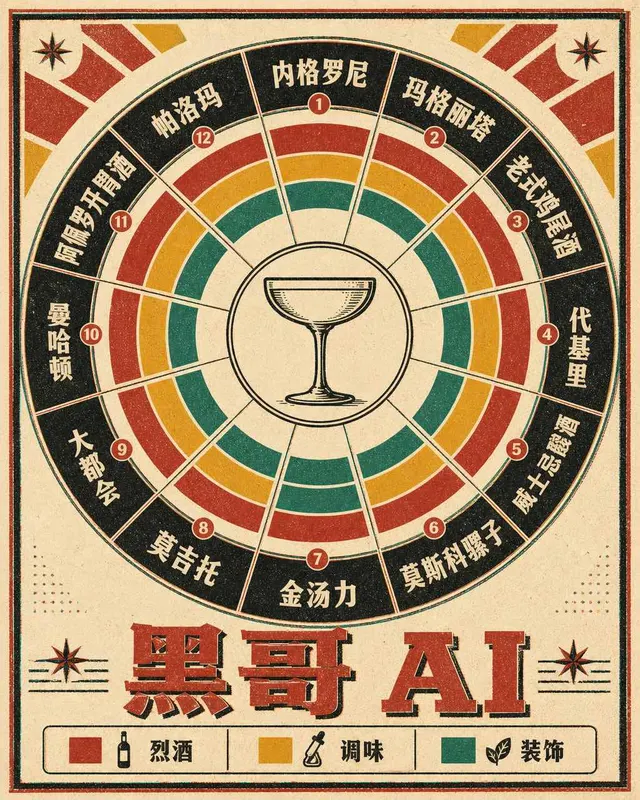
Classic Cocktail Mixing Ratios Wheel
A retro 1960s-style circular infographic — a cocktail mixing ratio wheel — printed on warm ivory card stock with bold offset-printing colors. The wheel is divided into twelve radi…