Naming Old Objects Anew
This is a Posters & Editorial AI image prompt case, leaning toward Poster, Photography. Copy the full prompt below and paste it into a free GPT image generator to create your own image with GPT Image-2 — swap the subject, brand, or aspect ratio as needed.
English full prompt
Create a “Naming Old Objects Anew” poster in a 1:1 frame for a small public culture event. Use an old object label peeled away to reveal its newly chosen name as the only metaphor. Show a real connection, material load, and contact shadow before the transformation; no transparent compositing. Set an asymmetric vertical composition. The viewer encounters the object change before the headline and participation details. Keep only four copy groups: “Naming Old Objects Anew,” “Small things also deserve to be remembered,” “the neighborhood repair room,” and “bring one repairable object.” The hero may cover one stroke edge only. Keep supporting objects within worn edges, repair stitches, and tool shadows. Combine dyed fiber paper with real stitched thread and deep-sea blue, shell white, seaweed green, and persimmon orange without an all-over aging filter. Set illumination to diffuse overcast daylight, separating believable highlights from paper diffusion and avoiding theatrical bloom. Keep a five-percent trim-safe margin and preserve small-copy legibility. Show no wall mockup, handheld view, QR code, trademark, public figure, existing character, HUD, or luminous dimensional type. For the final rendering, treat the central motif as an editorial sculpture: an old object label peeled away to reveal its newly chosen name. Retain small traces of handling, such as pressure, fiber lift, or abrasion, only where the object would actually be touched. Make the venue and participation note readable at arm’s length in the finished print. Final art direction: editorial poster design with a disciplined grid and material-aware composition. Use this controlled palette as the dominant visual system: #F2EBDD, #243447, #C65D48, #D6A14B; preserve believable local material colors within it. Preserve the requested text hierarchy and wording as part of the design, but do not invent extra slogans, pseudo-text, logos, or watermarks. Keep one unmistakable primary subject or information route and one readable visual action. Use disciplined negative space and avoid default perfect symmetry. Physical credibility is mandatory: correct gravity, contact shadows, material thickness, tool weight, joint loading, fabric tension, liquid direction, reflections, scale, and occlusion. Create an original visual with no resemblance to a public figure, copyrighted character, existing campaign, or living artist signature style. No unrelated decorative icons, floating objects, duplicated limbs, plastic gloss, waxy skin, synthetic collage artifacts, or AI watermarks. Return exactly one finished image composed for 1:1; no variants, process sheet, split panels, mockup frame, or contact sheet.
中文完整提示词
生成一张「旧物新名字」海报,画幅 1:1,用于一场小型公共文化活动。主视觉只使用“旧物标签撕下后显露新名称”这一隐喻,连接点、材料受力和接触影必须真实,不能用透明叠图伪造。版式定为偏心竖构图;观者先看到物件变化,再读标题和参与信息,服务于「旧物新名字」的单一视觉命题。海报只保留四组文字:「旧物新名字」「不用宏大,也值得被记住」「街区共修间」「带一件可修旧物」,标题仅允许一处边缘遮挡。辅物控制在磨损边缘、缝线和工具投影三类以内;选择染色纤维纸与真实缝线与深海蓝、壳白、海藻绿与柿橙,拒绝覆盖式旧化滤镜。照明设为阴天漫射天光,高光与纸面漫反射分别可信,不做舞台泛光。四边保留 5% 裁切安全区,小字在最终尺寸下可读;不展示墙面样机、手持效果、二维码、商标、名人、现成角色、HUD 或发亮厚字,保持「旧物新名字」的公共活动语气。
Related cases
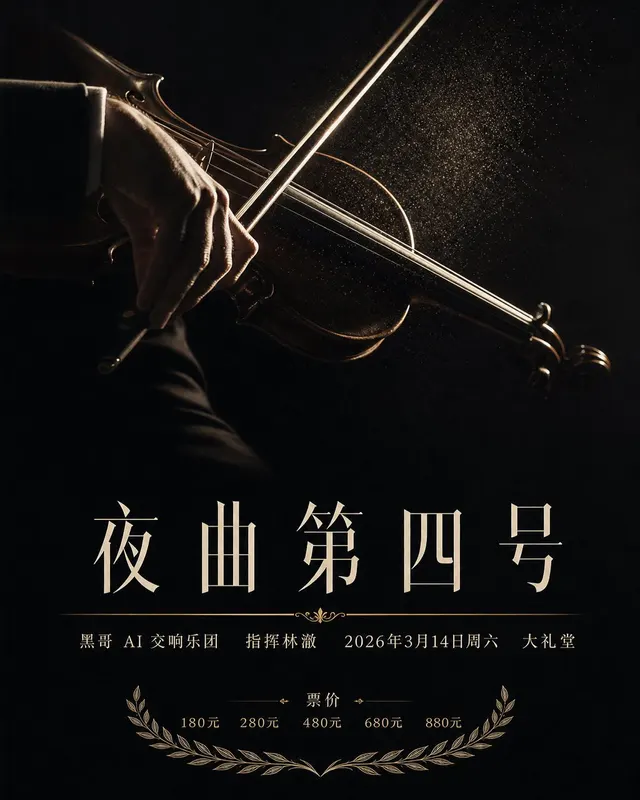
Symphony Orchestra Concert Poster
A vertical concert poster, 70x100cm proportions, for a symphony performance. Centered on a deep ink-black background floats a single high-contrast photograph of a violinist's hand…
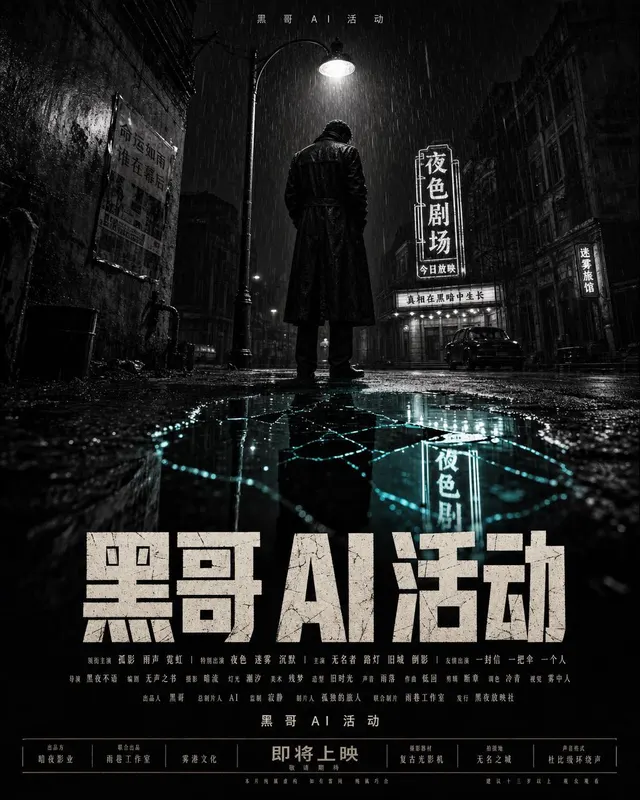
Neo-Noir Detective Movie Poster
A theatrical one-sheet for a fictional neo-noir film, 27x40 inch portrait ratio. Composition: a low-angle shot of a lone figure in a long coat standing under a single overhead str…
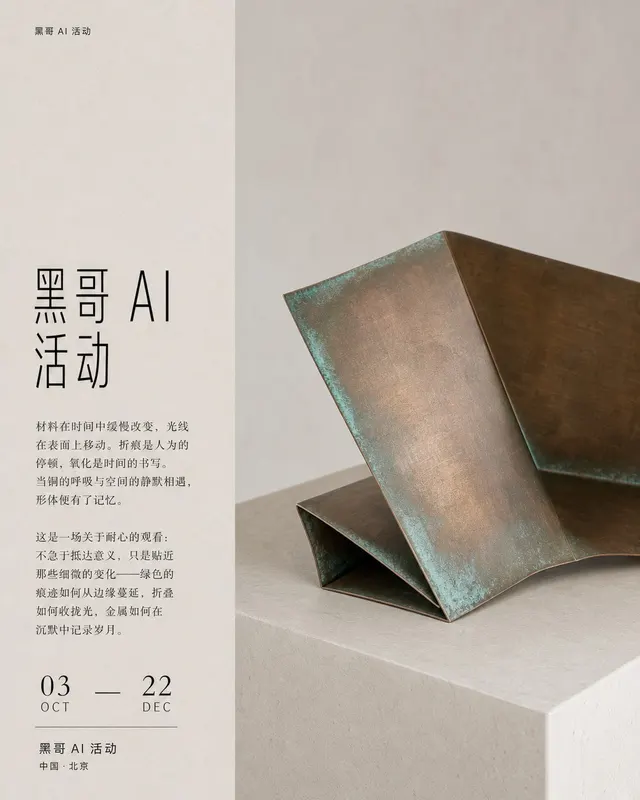
Contemporary Art Exhibition Poster
A square A1-scaled exhibition poster for a contemporary sculpture show. Background is warm chalk gray. A single oversized photographic object dominates the right two-thirds: a fol…
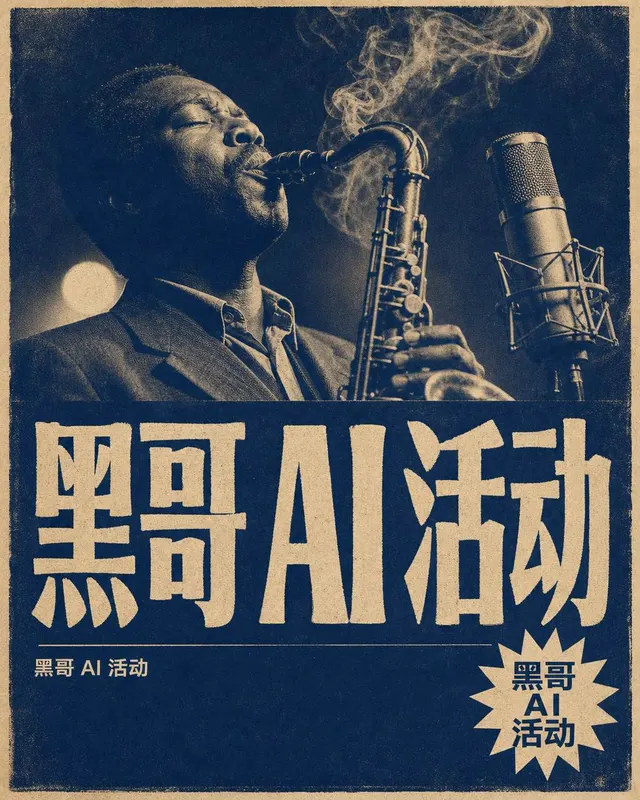
Underground Jazz Night Poster
A B2 portrait poster advertising a weekly jazz night at a basement club. Style: 1960s blue-note record-sleeve influence, but invented anew. The top half is a single duotone photog…