身体信号与应对图
这是一个「信息图与示意图」类别的 AI 生图提示词案例,风格偏向数据叙事、主题信息图、精确标注。复制下方完整提示词,打开免费 GPT 生图工具粘贴,即可用 GPT Image-2 免费出图,并可替换主体、品牌名与画幅。
中文完整提示词
以「身体信号与应对图」为题生成一体化视觉作品,实际用途是分明解释「身体信号与应对图」的层次、关系与行动线索。
以人体轮廓周围悬浮七张信号卡,胸口、肩颈、胃部和睡眠用强弱脉冲相连搭建整张信息图,因果、时间、空间或数量关系沿一条明确路径展开
人体轮廓周围悬浮七张信号卡,胸口、肩颈、胃部和睡眠用强弱脉冲相连
把「身体信号与应对图」的每一项主题变量直接放在对应对象旁:编号承担顺序,箭头承担方向,尺度承担量级,相对色阶只表达强弱;缺少可靠数值时不填造百分比。
以九宫格节奏但突出中央单元构图,按接近正交的平视或俯视图,必要局部用微距示意取景。
视觉作品可读文字包括「身体信号与应对图」及少量对象名称,删除营销套话与随机字符。
以夜蓝、荧光青、酸橙绿与银灰控制情绪,采用柔和定向光刻画清晰矢量线、哑光纸纹、半透明叠色与可逐项对应的图例的软硬、透明度与磨损。
「身体信号与应对图」的视觉条件依次是窗边自然光、主视觉与局部说明共享一条视线、留有呼吸空间的单色底;矢量边缘、箭头端点、图例色块和半透明叠层维持精确对齐。可见文字按紧凑标题配留白充分的说明字编排,并以清爽的编辑信息图质感结束。补充控制:层次直观的浅灰投影,矢量轮廓、图例边界与叠层接线维持清晰;用透明度差区分信息层,视线从标题进入核心对象而不绕行,唯一强调只落在决定性节点。
排除箭头相互冲突、图例错配、伪统计、密集小字与装饰性仪表盘,并排除可信商标、现成 IP、公众人物、畸形手部、错误透视与乱码。
成片为单张 3:2,不附过程页或变体。
English full prompt
Generate a complete visual work titled “Recognizing Chronic Stress,” whose practical purpose is clearly explaining the structure, relationships, and actionable cues of “Recognizing Chronic Stress”. Build the infographic by asking the image to surround a body silhouette together with signal cards connecting chest, neck, stomach, and sleep through pulse intensity, allowing cause, time, stage, or quantity to follow one unmistakable route. Surround a body silhouette accompanied by signal cards connecting chest, neck, stomach, and sleep using pulse intensity. In Recognizing Chronic Stress, stage each variable beside the element it describes: numbers carry sequence, arrows carry direction, scale cues carry magnitude, and tonal steps express relative intensity; omit percentages when no verified quantity is supplied. Arrange Recognizing Chronic Stress as nine-cell rhythm accompanied by a dominant center, seen using a near-orthographic eye-level or overhead view accompanied by macro explanation only where needed. Readable text consists of “身体信号与应对图” and a few object names; remove marketing filler and random characters. Control mood using night blue, luminous cyan, lime green, and silver gray; soft directional light should describe the hardness, transparency, and wear of crisp vector lines, matte paper grain, translucent overlays, and a one-to-one legend. The visual conditions for Recognizing Chronic Stress are natural window light, one sight line shared by the hero view and detail, and a single-color field with breathing room. Across the main object, align vector edges, arrow endpoints, legend swatches, and translucent overlays precisely. Arrange observable language as compact title with generously spaced explanatory type and close the image with a clean editorial-infographic finish. Additional control: clearly layered pale-gray shadows; vector contours, legend boundaries, and overlay connections stay crisp. Use opacity contrast separating information layers, ensure the eye enters via the title and reaches the main object explicitly, and let the sole accent sits on the decisive node. Exclude conflicting arrows, mismatched legends, fabricated statistics, dense microtext, or decorative dashboards, along using real trademarks, existing IP, public figures, malformed hands, false perspective, and gibberish. Return one 3:2 final image without variants or a process sheet. Final art direction: clear information design with a coherent visual route and restrained editorial structure. Use this controlled palette as the dominant visual system: #F2EFE7, #27384B, #6D8F89, #C96A43; preserve believable local material colors within it. Preserve the requested text hierarchy and wording as part of the design, but do not invent extra slogans, pseudo-text, logos, or watermarks. Keep one unmistakable primary subject or information route and one readable visual action. Use disciplined negative space and avoid default perfect symmetry. Physical credibility is mandatory: correct gravity, contact shadows, material thickness, tool weight, joint loading, fabric tension, liquid direction, reflections, scale, and occlusion. Create an original visual with no resemblance to a public figure, copyrighted character, existing campaign, or living artist signature style. No unrelated decorative icons, floating objects, duplicated limbs, plastic gloss, waxy skin, synthetic collage artifacts, or AI watermarks. Return exactly one finished image composed for 3:2; no variants, process sheet, split panels, mockup frame, or contact sheet.
相关案例
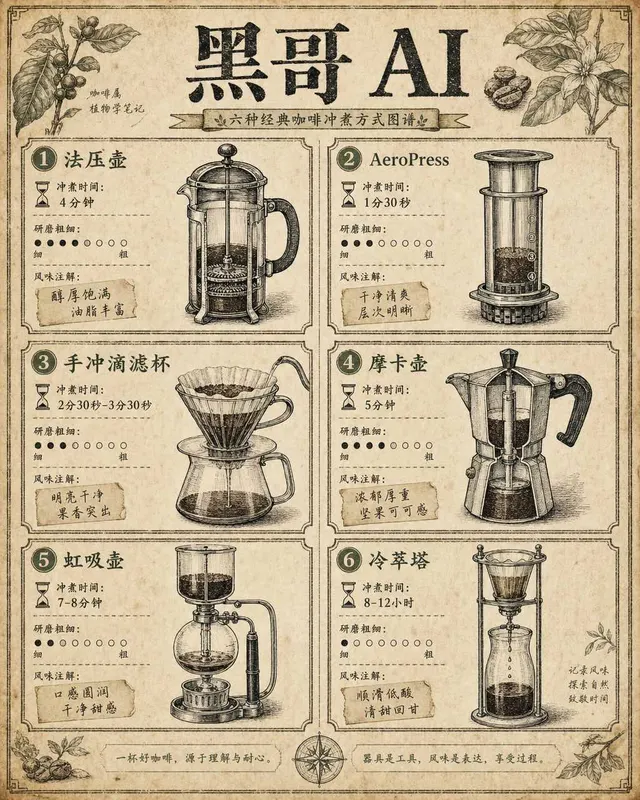
咖啡冲煮方式对比图
一张复古百科全书风格的信息图,在米白色做旧纸张上以两列网格排列六种咖啡冲煮方式对比。每个格子内有手绘钢笔风格剖面插图——法压壶、AeroPress、手冲滴滤杯、摩卡壶、虹吸壶、冷萃塔——配精细交叉阴影线增加立体感。每个设备下方以三行列出:冲煮时间(沙漏图标+文字)、研磨粗细(粗细刻度点)和风味注解(手写标签如 「bo…
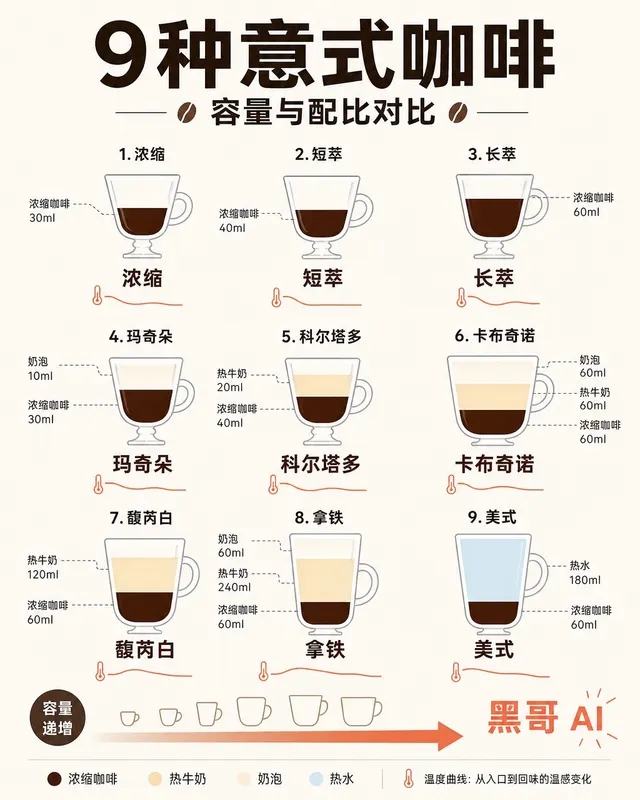
意式浓缩饮品配比示意图
一张简洁扁平风格信息图,将九种意式咖啡饮品——espresso、ristretto、lungo、macchiato、cortado、cappuccino、flat white、latte、americano——以高脚杯/咖啡杯轮廓横排展示。每个容器内用分层色块表示浓缩咖啡(深棕)、牛奶(暖奶油)、奶泡(浅象牙)和水(…
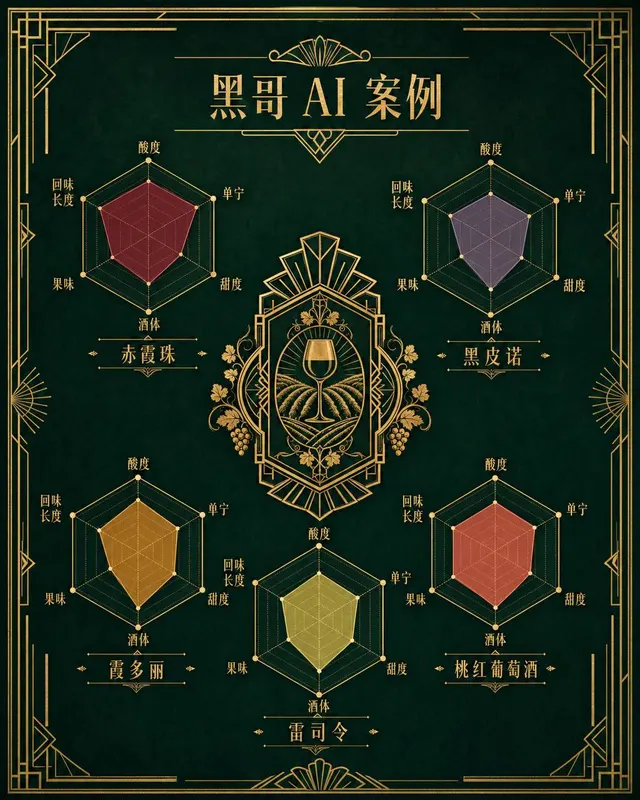
葡萄酒风味雷达图
一张装饰艺术风格的葡萄酒风味雷达图海报,展示五款经典葡萄酒:Cabernet Sauvignon、Pinot Noir、Chardonnay、Riesling 和 Rosé 的味觉雷达图。五个六边形雷达图对称排列在中央装饰徽章周围。每个雷达图有六条轴线——酸度、单宁、甜度、酒体、果味、回味长度——填充半透明多边形展示…
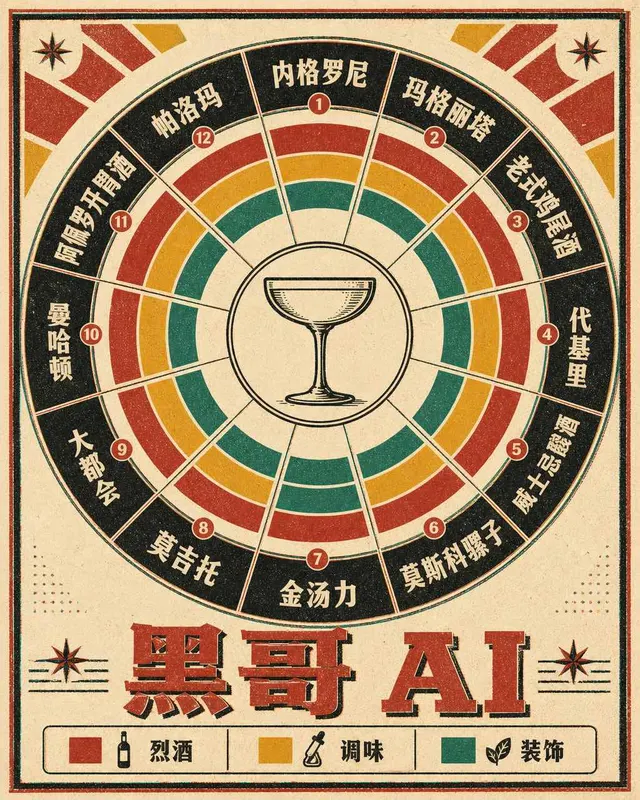
经典鸡尾酒配比转盘图
一张复古1960年代风格的圆形鸡尾酒配比转盘图,印在暖象牙色卡纸上,使用大胆的胶版印刷色彩。转盘分为十二个放射形扇区,每个代表一款经典鸡尾酒:Negroni、Margarita、Old Fashioned、Daiquiri、Whiskey Sour、Moscow Mule、Gin & Tonic、Mojito、Cos…